Liquid King Netherlands Expansion: Premier Wealth Management Company & Private Family Office Advisory in the Netherlands
How Liquid King and Aryan Anna Group advise principals in the Netherlands. A wealth management company brief for families whose capital sits in an Amsterdam canal house, a holding BV on the Zuidas, a Rotterdam port company, and a grower in Westland or the Bollenstreek, with commercial money lending kept off the family home.
Published .
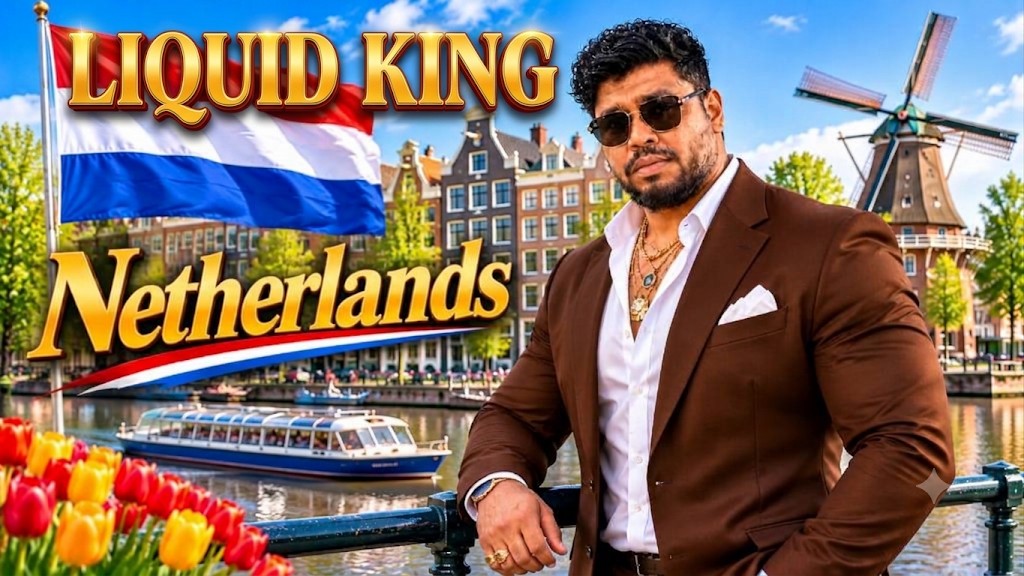
Private wealth in the Netherlands rarely starts as a line on a brokerage statement. It sits in a canal house on the Herengracht whose title is in one person's name, a holding BV whose shares pass only by a deed before a Dutch notary, an operating company in Rotterdam that is paid when a ship is discharged, and a greenhouse or bulb firm whose season is the tulip crop in the foreground of the banner. Children of these houses often live in London, Singapore, or Dubai. The red, white, and blue flag over the canal, the gabled houses, the rondvaart boat, and the windmill are the picture of the country. The family balance sheet is the BV, the house, and the contract that actually gets paid.
Liquid King, the advisory brand of Aryan Anna Group, is extending its wealth management company work into the Netherlands under the line Where Vision Becomes Legacy. The mandate is for principals in Amsterdam, Rotterdam, The Hague, Westland, and the Bollenstreek who want family capital mapped on its own page, apart from the operating BV and apart from any business that earns outside the Netherlands. Where that business needs liquidity, Liquid King money lending is written as a company facility, with its own borrower, purpose, and repayment. The canal house, the personal account, and any asset the family has not agreed to charge stay outside that document.
The Grachtengordel is where the family often lives, even when the holding company sits on the Zuidas and the cargo sits in Europoort or on the Maasvlakte. The Zuidas, along Gustav Mahlerlaan and around Amsterdam Zuid station, is where the private bank, the notary, and the accountant actually meet. Rotterdam is where a trading or terminal company earns. The Hague and Scheveningen are where an international household keeps a home while the company is registered somewhere else. A wealth plan that folds all of this into one discretionary portfolio will miss the title at the Kadaster, the Chamber of Commerce extract, the participation exemption, and the single director who can still bind the BV.
What a Dutch Family Actually Owns
The first meeting is an inventory. Liquid King asks which assets earn, which assets are only lived in, and which already carry a bank mortgage, a pledge, or a lease. In this market those three lists rarely match the name on the doorbell.
- The operating company is usually a besloten vennootschap, a BV, owned by a holding BV. The articles say who may sign and who may charge an asset. That authority is on the Chamber of Commerce extract. One director can bind the firm when the articles allow it. The wealth file copies the extract before anyone treats a personal promise as a company promise.
- A canal house in Amsterdam can stand in a personal name or in a BV. The house the family lives in is taxed as the owner-occupied home in Box 1. A house that is let, or held only as an investment, is a different line, and a residential lease can fall under Dutch rent regulation. The lawful rent is the rent in the file.
- A terminal, a tank, a warehouse, or a trading book in Rotterdam is company property. Freight, storage, and the buyer's payment arrive in the company. That cash is company money until a lawful salary or a lawful dividend says otherwise.
- Personal accounts and company accounts move on different clocks. The Netherlands uses the euro. A United Kingdom, Singapore, Dubai, or Hong Kong company beside the Dutch group may still be paid in another currency. That receipt stays in the company that earned it.
- Cross-border holdings are already the normal case. A qualifying stake of at least 5 percent can bring a subsidiary inside the participation exemption, so the same profit is not taxed again when it reaches the Dutch holding. The private shareholder meets Box 2 when the holding itself distributes or when the shares are sold. Those are two different tax moments, and the file keeps them apart.
Family Governance When One Director Can Bind the BV
Dutch families are still often identified with one principal, even when the next generation lives between London and Singapore and the canal house stays in Amsterdam. Liquid King helps the family write who owns the holding BV, who can offer a house or a receivable as security, and what stays outside the business: the residence, personal accounts, and any money lending exposure taken for yield.
The Dutch tool for that split is often a STAK, a stichting administratiekantoor. The foundation holds the shares and issues depositary receipts. Voting can stay with a board the family trusts. Economic rights can pass to children without handing them the signature that binds the company. Where the family prefers to keep the shares direct, the articles and a shareholders' agreement do the same work. A short family constitution, a distribution rule, and a liquidity reserve sit beside those documents, so a death, a dispute, or a quiet season at the port has a source of cash other than a forced sale of the home.
A will signed in London, Singapore, or Dubai does not, by itself, transfer the shares of a Dutch BV or retitle a house at the Kadaster. Share transfers go through a Dutch civil-law notary. The file records which asset sits in which country, and the notary is in that conversation before a foreign will is treated as enough. A shareholder who works in the BV is expected to take a customary salary, taxed in Box 1. A dividend is taxed in Box 2, and Dutch dividend withholding tax, generally 15 percent on a distribution to a private shareholder, is credited against that Box 2 tax. The two are not interchangeable. Overseas accounts are mapped and kept visible to the people who will inherit them. The wealth file does not rely on hiding the owner.
Strategic City-by-City Wealth Advisory in the Netherlands
Liquid King delivers wealth management company work across the places where Dutch family capital actually sits, because a Herengracht residence and a Maasvlakte terminal do not need the same conversation.
Liquid King Amsterdam: The Canal Belt and the House
The banner is this city seen as a picture: the Dutch flag, the canal, the gabled houses of the seventeenth-century canal ring, a tour boat, and tulips. The canal ring inside the Singelgracht is a UNESCO site, and a grachtenpand on the Herengracht, Keizersgracht, or Prinsengracht is often the family home. Liquid King Amsterdam treats that house as a Box 1 residence unless the family has deliberately put it to another use. The company that earns is not the house. Commercial money lending for an operating BV is introduced on its own term sheet, apart from the family mandate, and the house enters that term sheet only when the family has agreed, in writing, to offer it.
Liquid King Zuidas: The Holding BV and the Private Bank
The Zuidas is where the wealth decision is documented. Law firms, notaries, tax advisers, and private banks line the southern axis. Liquid King Zuidas advises principals on the line between a bank portfolio and the family balance sheet, on a holding BV that owns the operating companies, and on a United Kingdom, Singapore, or Dubai company that is already on the structure chart. A discretionary portfolio booked with a firm authorized by the Autoriteit Financiële Markten stays with that firm. The holding company, the STAK, and the distribution policy are a separate note.
Liquid King Rotterdam: The Port and the Operating Company
Rotterdam is Europe's largest seaport. Waalhaven, Botlek, Europoort, and the Maasvlakte move containers, breakbulk, oil products, and dry bulk. Wilhelminapier and Kop van Zuid are where the office that manages a terminal or a trading book often sits. Liquid King Rotterdam treats that operating BV as the earning asset, with its own contracts, its own bank account, and its own place in the succession file. The family's canal house is not the collateral for a cargo bill unless the family has agreed to offer it. A quiet month on the quay is a company problem with a company reserve.
Liquid King The Hague, Westland, and the Bollenstreek
The Hague is the seat of government and of a large international community. Scheveningen and Statenkwartier are where many of those households actually live. Westland, between The Hague and the Hook of Holland, is greenhouse country. The Bollenstreek, between Leiden and Haarlem, is the bulb region behind the tulips on the banner. Liquid King keeps three notes: the residence, the international salary or treaty position, and the grower's BV with its season, its energy bill, and its export contracts. The windmill on the banner belongs to the same Dutch picture. Kinderdijk and the Zaanstreek are real mill landscapes. They are scenery in this mandate. The balance sheet is the house, the BV, and the crop contract.
Regulatory Compliance and the Three Boxes
Wealth advisory that touches the Netherlands sits beside two supervisors. The Autoriteit Financiële Markten oversees conduct, including investment services and the managers of alternative investment funds. De Nederlandsche Bank is the prudential supervisor, and significant banks are also supervised with the European Central Bank. A portfolio, an investment recommendation offered as a business, or a fund stays with a firm that already holds the authorization, or that passports it into the Netherlands. Anti-money laundering duties sit under the Wet ter voorkoming van witwassen en financieren van terrorisme. Aryan Anna Group and Liquid King apply Know Your Customer, Anti-Money Laundering, and Ultimate Beneficial Ownership checks on every mandate.
Personal tax is organized in three boxes, and the wealth file says which asset falls in which one. Work, and the house the family lives in, fall in Box 1, including the salary a BV pays a shareholder who works in the company. A substantial interest, generally 5 percent of the shares together with a fiscal partner, falls in Box 2. For 2026 the Box 2 rate is 24.5 percent up to €68,843 and 31 percent on the income above that. Savings and investments held personally, outside the company, fall in Box 3. Since the Supreme Court judgment of 24 December 2021, tax in that box cannot rest on a deemed return higher than the actual return. The file records the actual assets.
The BV itself pays corporate income tax. For 2026 the rate is 19 percent on a taxable amount up to €200,000 and 25.8 percent above that. Qualifying innovation profit can fall in the innovation box at 9 percent. A dividend or gain from a qualifying participation of at least 5 percent is generally exempt at the holding, which is what the participation exemption is for. The exemption does not turn a private shareholder's dividend into untaxed income. That dividend is still Box 2. Liquid King does not take deposits from the public in the Netherlands, and it does not present itself as an AFM-authorized investment firm or as a Dutch bank.
"We don't just invest in businesses, we invest in people, vision and a better tomorrow." — Aryan Anna, Founder & Visionary
Connecting Dutch Family Capital with Holdings Abroad
Liquid King Netherlands links family wealth in Amsterdam, the Zuidas, Rotterdam, The Hague, Westland, and the Bollenstreek with the United Kingdom, Singapore, Dubai, and Hong Kong. Contact the Netherlands advisory desk to discuss a family mandate that keeps the canal house, the operating BV, and any money lending exposure in separate documents.